
Module 2 – Scales & Arpeggios
Your first step towards the ABRSM Saxophone Grade 1 exam.
Scales and arpeggios are an essential part of learning the saxophone. They help you improve your finger coordination, develop a steady rhythm, and become more confident with your instrument.
In this module, you will learn the three scales and arpeggios required for the ABRSM Grade 1 Saxophone Practical Exam.
Take your time, practise slowly, and focus on playing every note clearly.
By the end of this module, you should be able to:
Play C Major, F Major, G Major and D Minor scales.
Play the corresponding arpeggios.
Perform each exercise ascending and descending over one octave.
Play with both tongued and slurred articulation.
Perform all exercises from memory.
A scale is a sequence of notes played in ascending (going up) and descending (going down) order. Practising scales helps you:
Improve finger coordination.
Recognise different keys.
Develop better breath control.
Play more confidently and accurately.
We will begin with the easiest scale and gradually introduce new notes.
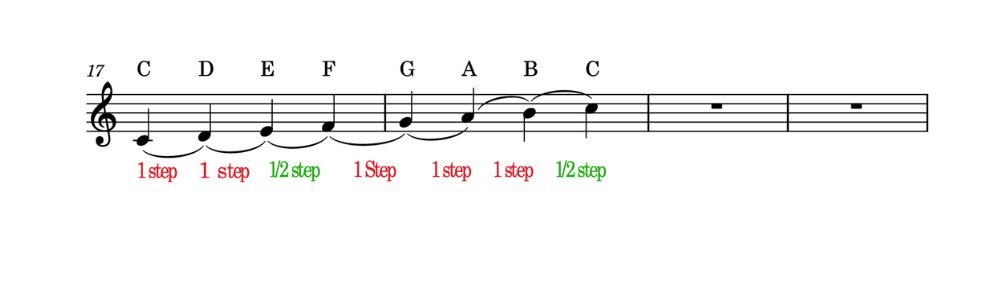
Major Scale construction : Understanding Whole Steps and Half Steps
A whole step (tone) is the distance of two semitones between two notes, while a half step (semitone) is the smallest interval in Western music.
In the C Major scale, the pattern is:
Whole – Whole – Half – Whole – Whole – Whole – Half
Notice that the half steps occur between E–F and B–C.
This pattern is the same for every major scale!
Learn Your Scales & Arpeggios
C Major – Your First Scale
Let’s start with C Major!
C Major is a great starting point because it contains no sharps or flats.
Scale:
C – D – E – F – G – A – B – C
Arpeggio:
C – E – G – C – G – E – C
Exercise 1 – Slow and Steady
Goal: Learn the notes and develop finger coordination.
Set your metronome to 60 BPM.
Play each note for 4 beats.
Start on C and continue up to the next C.
Play the scale back down.
Keep your air flowing and your fingers relaxed.
C – D – E – F – G – A – B – C – B – A – G – F – E – D – C
Repeat the exercise until you can play all the notes comfortably.
Practice Metronome
Exercise 2 – Follow the Beat
Goal: Improve your timing and coordination.
Set your metronome to 60 BPM.
First, play each note for 2 beats.
Then, play each note for 1 beat.
Keep the same tempo from beginning to end.
When you feel comfortable, gradually increase the tempo to 70 BPM, then 80 BPM.
Remember: Playing accurately is more important than playing fast!
Practice Metronome
Exercise 3 – Whole Steps and Half Steps
Goal: Recognise the half steps in the C Major scale.
Remember that the two half steps are between E–F and B–C.
Practise these short patterns:
E – F – E – F
B – C – B – C
Play each note for one beat at 60 BPM.
Listen carefully and focus on smooth finger movements.
Practice Metronome
Exercise 4 – Tongued and Slurred
Goal: Develop your articulation.
Play the complete C Major scale in two different ways.
1. Tongued: Articulate every note gently using your tongue.
2. Slurred: Connect all the notes smoothly without tonguing between them.
Start at 60 BPM, playing one note per beat.
Try to maintain a consistent sound and steady airflow.
Practice Metronome
Exercise 5 – C Major Arpeggio
Goal: Improve coordination when moving between different notes.
Now let’s practise the C Major arpeggio.
C – E – G – C – G – E – C
Set your metronome to 60 BPM.
Play each note for 2 beats.
Repeat with 1 beat per note.
Practise both tongued and slurred.
Take your time with the finger changes.
Practice Metronome
Exercise 6 – Your First Scale Challenge!
Goal: Play independently and build confidence.
Can you complete the following challenge?
Play the C Major scale ascending and descending.
Play at 70 BPM, one note per beat.
Repeat using slurred articulation.
Play the C Major arpeggio.
Finally, try playing everything from memory!
Well done! Once you feel confident with C Major, you’re ready to discover your next scale: F Major.
Practice Metronome
F Major
Now that you are comfortable with C Major, let’s move on to F Major!
This scale introduces your first flat note: B♭ (B flat).
F Major follows the same whole-step and half-step pattern as C Major, but this time, we need to lower B by one semitone.
Scale:
F – G – A – B♭ – C – D – E – F
Arpeggio:
F – A – C – F – C – A – F
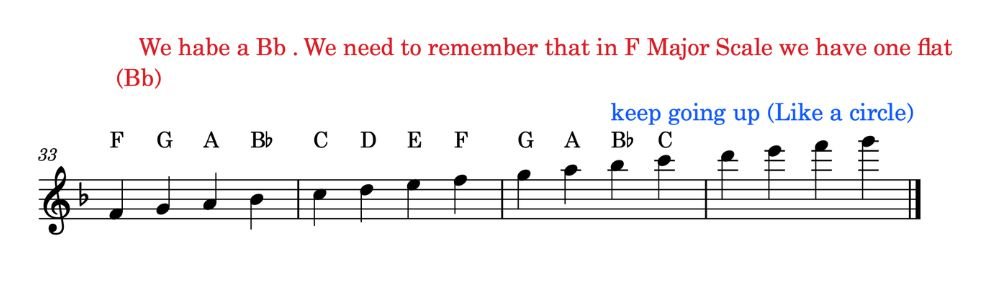
Exercise 1 – Learn Your F Major Scale
Goal: Become familiar with the notes and practise B♭.
Play the scale ascending and descending.
Hold each note for 2 beats.
Pay special attention to B♭.
Keep your fingers relaxed and your airflow steady.
Once comfortable, try playing one note per beat.
Practice Metronome
Exercise 2 – Focus on B♭
Goal: Improve finger coordination around B♭.
Practise these short patterns:
A – B♭ – C – B♭ – A
G – A – B♭ – C – B♭ – A – G
Play slowly at 60 BPM, one note per beat.
Repeat each pattern until the finger movements feel natural.
Practice Metronome
Exercise 3 – Tongued and Slurred
Goal: Improve articulation and control.
Play the complete F Major scale in two different ways:
Tongued: Articulate every note gently.
Slurred: Connect all the notes smoothly without tonguing between them.
Keep a steady tempo and listen carefully to your sound.
Practice Metronome
Exercise 4 – F Major Arpeggio
Goal: Develop smooth finger coordination.
F – A – C – F – C – A – F
Start at 60 BPM.
Play each note for 2 beats.
Repeat with one note per beat.
Practise both tongued and slurred.
Finally, try playing from memory.
Practice Metronome
Your F Major Challenge!
Can you play the F Major scale and arpeggio at 70 BPM, ascending and descending, without looking at the notes?
Remember: a steady rhythm and a clear sound are more important than speed!
Practice Metronome
G Major
Now that you’re comfortable with F Major, let’s move on to G Major!
This scale introduces your first sharp note: F♯ (F sharp).
G Major follows the same whole-step and half-step pattern as C Major, but this time, we need to raise F by one semitone.
Scale:
G – A – B – C – D – E – F♯ – G
Arpeggio:
G – B – D – G – D – B – G
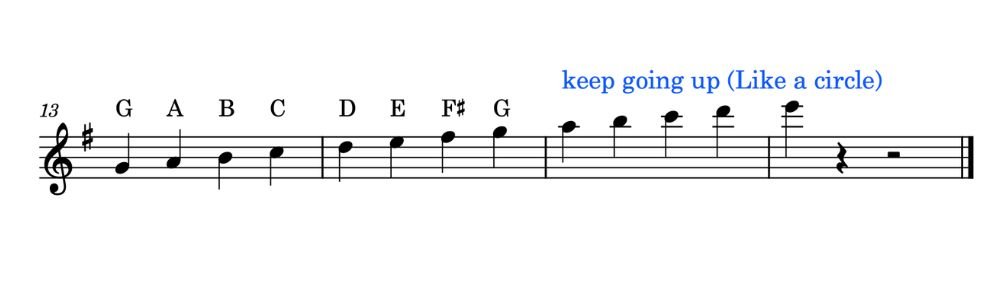
Exercise 1 – Learn Your G Major Scale
Goal: Become familiar with the notes and practise F♯.
Play the scale ascending and descending.
Hold each note for 2 beats.
Pay special attention to F♯.
Keep your fingers relaxed and your airflow steady.
Once comfortable, try playing one note per beat.
Practice Metronome
Exercise 2 – Focus on F♯
Goal: Improve finger coordination around F♯.
Practise these short patterns:
E – F♯ – G – F♯ – E
F♯ – G – A – G – F♯
Play slowly at 60 BPM, one note per beat.
Pay attention to the half-step movement between F♯ and G.
Repeat each pattern until the finger movements feel natural.
Practice Metronome
Exercise 3 – Tongued and Slurred
Goal: Improve articulation and control.
Play the complete G Major scale in two different ways:
Tongued: Articulate every note gently.
Slurred: Connect all the notes smoothly without tonguing between them.
Keep a steady tempo and maintain a consistent sound.
Practice Metronome
Exercise 4 – G Major Arpeggio
Goal: Develop smooth finger coordination.
G – B – D – G – D – B – G
Start at 60 BPM.
Play each note for 2 beats.
Repeat with one note per beat.
Practise both tongued and slurred.
Finally, try playing from memory.
Practice Metronome
Your G Major Challenge!
Can you play the G Major scale and arpeggio at 70 BPM, ascending and descending, without looking at the notes?
Remember: focus on accurate finger movements, a steady rhythm and a beautiful sound!
Practice Metronome
D Natural Minor
Now that you’ve learned your major scales, let’s discover your first minor scale!
Minor scales have a different sound from major scales. They often create a softer, more emotional or melancholic atmosphere.
For your Grade 1 preparation, we will focus on D Natural Minor.
This scale contains one flat: B♭ (B flat), just like F Major.
Scale:
D – E – F – G – A – B♭ – C – D
Arpeggio:
D – F – A – D – A – F – D
Understanding the Natural Minor Scale
D Natural Minor is the relative minor of F Major.
This means both scales contain exactly the same notes, but they start on different notes and have a different tonal centre.
Did you know?
For the ABRSM Grade 1 exam, you can choose the natural, harmonic or melodic form of the minor scale. In this course, we will use D Natural Minor.
Exercise 1 – Learn Your D Natural Minor Scale
Goal: Become familiar with the notes of D Natural Minor.
Play the scale ascending and descending.
Hold each note for 2 beats.
Pay special attention to B♭.
Keep your fingers relaxed and maintain a steady airflow.
Once comfortable, try playing one note per beat.
Practice Metronome
Exercise 2 – Focus on the Minor Scale
Goal: Improve finger coordination and become familiar with the natural minor scale.
Practise these short patterns:
D – E – F – E – D
A – B♭ – C – B♭ – A
Play slowly at 60 BPM, one note per beat.
Listen carefully to the sound of the minor scale and focus on smooth transitions between notes.
Repeat each pattern until the finger movements feel natural.
Practice Metronome
Exercise 3 – Tongued and Slurred
Goal: Improve articulation and control.
Play the complete D Natural Minor scale in two different ways:
Tongued: Articulate every note gently using your tongue.
Slurred: Connect all the notes smoothly without tonguing between them.
Keep a steady tempo and maintain a consistent sound throughout the exercise.
Practice Metronome
Exercise 4 – D Minor Arpeggio
Goal: Develop finger coordination and confidence.
D – F – A – D – A – F – D
Start at 60 BPM.
Play each note for 2 beats.
Repeat with one note per beat.
Practise both tongued and slurred.
Finally, try playing from memory.
Remember: The D Minor arpeggio stays the same whether you choose the natural, harmonic or melodic minor scale.
Practice Metronome
Your D Natural Minor Challenge!
Can you play the D Natural Minor scale and D Minor arpeggio at 70 BPM, ascending and descending, without looking at the notes?
Try playing both tongued and slurred, keeping a steady rhythm and a clear sound.
Congratulations! You have now practised all four scales and arpeggios in this module.
 English (UK)
 Français