

How to Learn Saxophone Online: A Complete Step-by-Step Method
I’ve been teaching saxophone for years — in person in Dubai, and online with students from all over the world. And the question I get the most, before anyone even picks up the instrument, is always the same: “Where do I actually start?”
That’s exactly why I built my online saxophone method. Not a collection of random YouTube videos. Not a PDF you download and never open again. A real, progressive, structured path — from the very first breath to your first improvisation.
Here’s how it works, level by level.
Why most people struggle to learn saxophone on their own
The problem isn’t motivation. Most people who want to learn saxophone are genuinely excited about it. The problem is structure.
Without a clear path, you end up jumping between videos, practicing the wrong things, and hitting a wall after a few weeks. You’re not making progress — you’re just going in circles.
A good method solves this. It tells you exactly what to work on, in the right order, at the right pace.
The 5 levels of my saxophone method
My online method is built around 5 progressive levels, 20 modules in total. Each module includes lessons, exercises, and practice resources. Here’s the full roadmap.
Level 1 — Absolute Beginner
Start here if you’ve never played before.
This is where everything begins. Before you play a single note, you need to understand how the saxophone works — how to hold it, how to breathe, how to make your first sound. These first four modules cover exactly that: getting ready to play, producing a clear and stable sound, and learning your first notes.
By the end of Level 1, you’ll be playing real notes and understanding how the instrument responds to you. That feeling of making your first clean sound — there’s nothing like it.
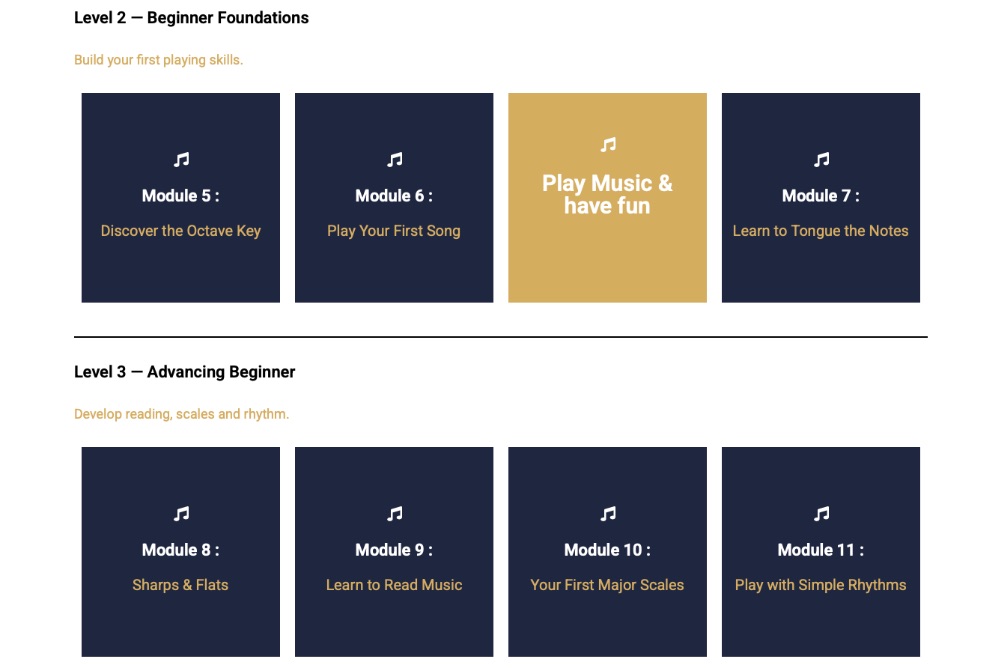
Level 2 — Beginner Foundations
Build your first real playing skills.
Once the basics are in place, we go deeper. You’ll discover the octave key (a game changer), play your first complete song, and start working on tonguing — the technique that gives your notes clarity and rhythm.
Level 2 is where it starts to feel like music, not just sound.

Level 3 — Advancing Beginner
Develop reading, scales and rhythm.
This is where many self-taught players get stuck. Reading music, understanding sharps and flats, learning your first major scales — it can feel overwhelming if you try to tackle it all at once.
In this level, we take it step by step. By the end, you’ll be reading basic sheet music with confidence and playing simple rhythms cleanly.
Level 4 — Developing Player
Expand your range and control.
Now we go further into the saxophone. Low notes, palm keys, the upper register — we explore the full range of the instrument. We also work on dynamics, expression, tone quality, and breath control for longer phrases.
This is the level where you stop sounding like a beginner.
Level 5 — Creative Player
Scales, improvisation, and musical freedom.
My favourite level to teach. Here we introduce pentatonic scales, the blues scale, and the fundamentals of improvisation. By the end of Module 20, you’ll be able to play — and improvise — with real confidence.
This is the moment students usually message me to say: “I finally feel like a musician.”
What else is included
Alongside the learning path, the Practice Room gives you access to a full library of lessons, exercises and practice resources you can use at any time:
- Sound & Breathing exercises
- Saxophone Notes & Fingerings
- Learn to Read Music
- Major Scales and Pentatonic Scales
- Patterns for Improvisation
- Articulation exercises
- A structured Practice Plan to organise your sessions
These resources are there whenever you want to revisit a specific topic, reinforce a skill, or simply practice at your own pace outside the main learning path.
Who this is for
This method works best if you’re a complete beginner or an early intermediate player who feels stuck. You have a saxophone (or are about to get one), you’re motivated, but you don’t know exactly what to do with your practice time.
It also works well as a complement to in-person lessons — several of my Dubai students use the Practice Room between our sessions to stay consistent and make faster progress.
It’s not designed for advanced players looking for repertoire or professional-level technique work. For that, private lessons are the better path.
How to access the Practice Room
The Practice Room is available as a monthly membership for €12/month. That gives you full access to all 5 levels, all 20 modules, all exercises and practice resources — everything.
If you’re one of my current students taking private lessons with me in Dubai or online, access is included — just reach out and I’ll get you set up.
Prefer in-person lessons? I also teach privately in Dubai — find out more here.
FAQ
No — and that’s intentional. The method starts from zero. Reading music is introduced gradually in Level 3, once you already know how to produce a good sound and play your first notes. You’ll learn to read music as part of the journey, not as a prerequisite.
Both. All the lessons and exercises work on alto saxophone and tenor saxophone. Where there’s a difference (fingering charts, transposition), I explain it clearly. Most beginners start on alto, but if you have a tenor, you’re absolutely fine.
20 to 30 minutes a day is enough to make solid progress. Consistency matters more than long sessions. The Practice Plan inside the Practice Room helps you structure your time so every minute counts.
Yes, absolutely. There’s no commitment. You can cancel whenever you want, and you’ll keep access until the end of your billing period.
No. If you’re one of my current students, access to the Practice Room is included in your lessons. Just send me a message and I’ll activate your account.


 English (UK)
 Français