
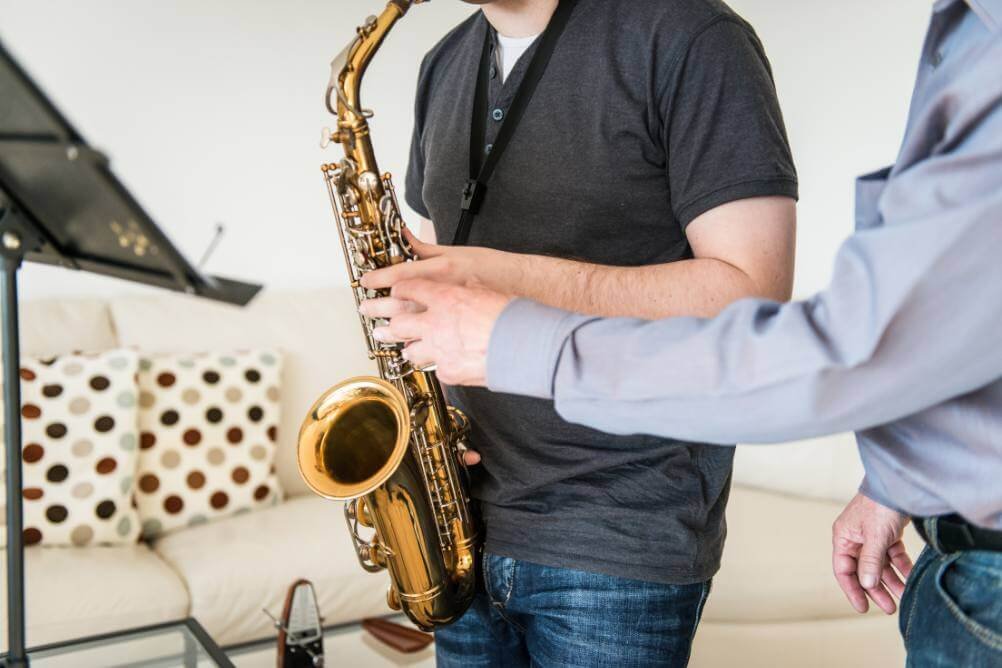
The Myth of the “Easy” Instrument

Many people believe the saxophone is one of the easiest instruments to learn. While it’s true that you can produce your first notes fairly quickly, mastering it requires technique, control, and consistent practice.
Compared to instruments like the violin, the saxophone is more accessible at the beginning. You can play simple melodies within weeks. However, developing a rich tone, good control, and musical expression takes time and structured practice.
The First Challenges You’ll Face
If you’re starting from scratch, here are the main challenges most beginners encounter:
Embouchure – Learning how to position your mouth and lips correctly is essential for a stable and controlled sound.
Breath control – Finding the right balance between air pressure and relaxation is key.
Finger coordination – Even though the saxophone is ergonomic, smooth transitions require repetition.
Reading music – Understanding basic notation can accelerate your progress significantly.
How Long Does It Take to Sound Good?

With consistent practice (20–30 minutes per day), most beginners can:
Play simple melodies within 2–3 weeks
Develop a decent tone and control within 6–12 months
Start exploring improvisation and musical expression over time
The key is not just how much you practice — but how you practice.
The Easiest Path: Learn with Guidance
Self-learning is possible, but many beginners feel lost after the first few weeks.
This is where structure becomes essential.
To solve this, I created a dedicated Student Practice Room — a structured online space designed to guide your daily practice.
Inside the Practice Room, you’ll find:
Sound & breathing fundamentals
Major, minor & pentatonic scales (all keys)
Technical exercises
Improvisation tools
A clear progression roadmap
Instead of wondering what to practice, you simply follow a system that keeps you improving every day.
👉 This is ideal if you want to progress independently while still having direction and clarity.
If you prefer a more guided experience, you can also explore my Saxophone lessons in Dubai, where I provide personalized coaching and feedback.
Your Complete Saxophone Practice System
From your first notes to improvisation — everything you need to improve, all in one place.
Why Most Beginners Struggle (And How to Avoid It)
The biggest mistake is practicing randomly.
Without structure:
You repeat the same exercises
You don’t track progress
You lose motivation
With the right system (like the Practice Room):
You know exactly what to do each session
You build real technique step by step
You stay consistent and motivated

Final Thoughts
So, is the saxophone hard?
It’s challenging enough to keep you engaged — but accessible enough to start enjoying music quickly.
With the right approach, you can avoid frustration and make steady progress.
Ready to Start Your Saxophone Journey?
f you want to improve with a clear and effective method, you can access the Student Practice Room and start building your skills today.
Or, if you’re based in Dubai and prefer one-to-one guidance:
📱 WhatsApp: +971 58 542 0635
📷 Instagram: @chris_onsax
🎷 More info: Saxophone Classes in Dubai
FAQ
Is saxophone really easy to learn?
It’s easy to start but takes time to master. The first notes come quickly, but tone and control require consistent practice.
Can I learn saxophone on my own?
Yes, but using a structured system like a practice program or lessons will significantly speed up your progress.
How often should I practice saxophone?
20–30 minutes daily is enough to see real progress if your practice is structured.
What is the fastest way to improve on saxophone?
Follow a clear routine that includes tone, technique, and musical exercises — like in a structured Practice Room.





 English (UK)
  Français